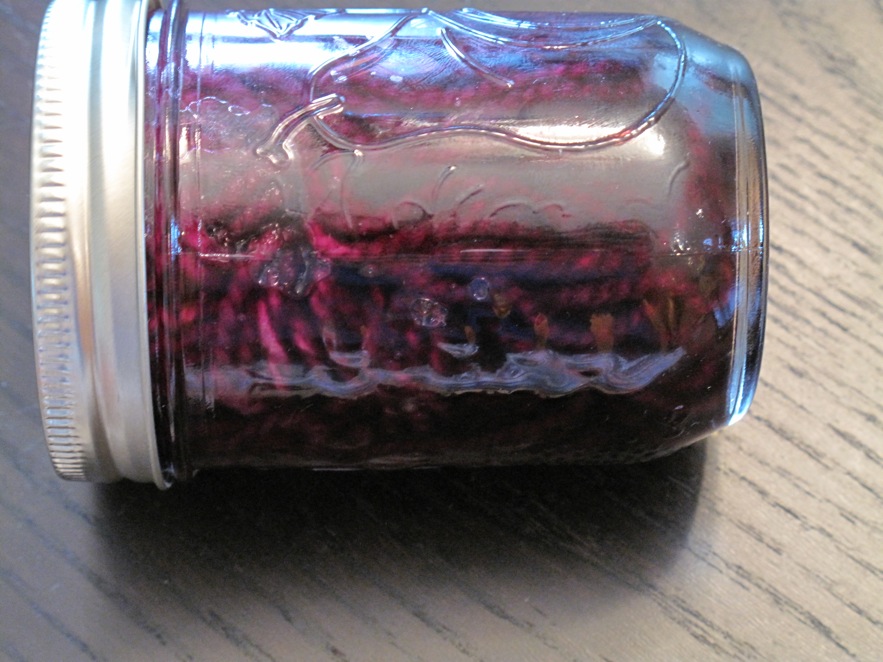
At yarn camp, we were given a jar of natural dye with yarn in it and told to leave it in a sunny place for at least a month. Today was the one-month mark, so this is my grand unveiling:
Also, I scoured my brown samples and I think the colours are a little more discernible now. This is the original one, followed by the new one:
Or not. They kind of look exactly the same. Oh well. The 100g brown dye test is on this weekend - stay tuned!
Jul 19, 2012
Jul 15, 2012
Samples done
First I got out all my gear. In the Becel container I have my yarn soaking in Synthrapol to scour it and get it ready for dye.
I have four little eyedroppers that have .25, .5. .75 and 1.0mL markings - that came in very handy. One for each colour meant no mix-ups.
I got an extra plastic cup and started mixing up my yellow, blue, red and brown. Here are all the ratios I used:
Looking at the wet yarn in its wee plastic-wrapped package, I could tell that the yellow had a lot of power. I did several tests without it and I think the one that I (and the wearer of the garment to be knit with said dyed yarn) choose will be one of the non-yellow ones. They turned out more golden brown and that's not a look my manly man is likely to like.
I had to keep the packages numbered to match the notes. Once they're dry, I'll staple them into the book so that the yarn goes with the record.
You can see the strong yellow in some, a more reddy nature to others, and the ones that are the deepest browns seem to be the ones with the most blue.
Now, here's the thing: I didn't measure the amount of dye to the weight of fibre because they were six-inch pieces of yarn and I didn't want to go there. So once we pick the winner, I'll do a proper test of that one using the right amount of dye for the weight of fibre, and see what colour I actually get. I may need to up it from my expected 2% in order to get it closer to the sample, but I can do that, so I'm not too worried. More testing is required, though.
Eventually a sweater will be born.
The Math
This is the calculation I used to get a 2% depth of shade on my 1100g of fibre using 15g of dye powder dissolved in 1L of water.
If we consider the dye company's instructions for 1% depth of shade using:
10g dye powder : 1L water
1000mL dyestock : 1000g of fibre
I could have used the same dyestock and doubled the volume of dyestock for the same weight of fibre. However, I used 1.5 times as much dye powder in my stock, so I have a stronger stock. Not quite enough to give me a 2% depth of shade (it would give me 1.5% using the same ratio of stock to fibre), so I have to calculate how much dyestock, given my stock strength, I need for the same 1000g of fibre.
1.5 x 4 = 6 / 3 = 2
I bolded those bits so we can see that I can also do 3/2 x 4/3. That gives us 12/6, which we all know as 2.
Right. So I need 4/3 (or 1 and 1/3) as much dyestock to get a 2% depth of shade on 1000g of fibre.
1000mL x 4/3 = 1333mL
Then we'll add in my 100g of fibre (I have 1100g total), so I'll take a tenth of 1333 and find it's about 133. I'll add them together, giving me 1466mL of dyestock required for 1100g of fibre.
You'll recall that I'm also going to be mixing colours to get the perfect doodoo brown, so once I figure out those ratios, I'll know exactly how much I need to mix up to get 1466mL. Then, for each 100g skein of yarn I'm dyeing, I'll need 133mL of dyestock. If I put more than one skein in the pot, I'll multiple 133 by however many skeins I'm using and then I should get dye exhaustion.
Also going into the pot are:
If we consider the dye company's instructions for 1% depth of shade using:
10g dye powder : 1L water
1000mL dyestock : 1000g of fibre
I could have used the same dyestock and doubled the volume of dyestock for the same weight of fibre. However, I used 1.5 times as much dye powder in my stock, so I have a stronger stock. Not quite enough to give me a 2% depth of shade (it would give me 1.5% using the same ratio of stock to fibre), so I have to calculate how much dyestock, given my stock strength, I need for the same 1000g of fibre.
1.5 x 4 = 6 / 3 = 2
I bolded those bits so we can see that I can also do 3/2 x 4/3. That gives us 12/6, which we all know as 2.
Right. So I need 4/3 (or 1 and 1/3) as much dyestock to get a 2% depth of shade on 1000g of fibre.
1000mL x 4/3 = 1333mL
Then we'll add in my 100g of fibre (I have 1100g total), so I'll take a tenth of 1333 and find it's about 133. I'll add them together, giving me 1466mL of dyestock required for 1100g of fibre.
You'll recall that I'm also going to be mixing colours to get the perfect doodoo brown, so once I figure out those ratios, I'll know exactly how much I need to mix up to get 1466mL. Then, for each 100g skein of yarn I'm dyeing, I'll need 133mL of dyestock. If I put more than one skein in the pot, I'll multiple 133 by however many skeins I'm using and then I should get dye exhaustion.
Also going into the pot are:
- 220g salt
- 55mL acetic acid (each adjusted for 1100g of fibre)
Look how that works out, will you? Divide those numbers by 11 (one for each skein), and you get:
- 20g salt
- 5mL acetic acid
Nice and even. I'll be using half the amount at the beginning, then I'll add the other half of the salt after 20 minutes of cooking and the rest of the acid after 40 total minutes. I'll leave it on to cook for close to an hour, then pull it off and let it cool in the pot so it doesn't felt. It'll continue to take up dye if there's any left to take up after an hour.
I think we're set. Let's go make the perfect brown ... and do some laundry so I have something to wear this week.
Jul 14, 2012
I love it when a plan comes together
Step 1 - Create dyestocks ... CHECK!
From left to right, we have Jacquard acid dye in Chestnut, then Ciba colours Cobalt, Golden Yellow and Red.
When you look at them from above, the sun casts a shadow with a highlight that shows the colour:
(in this one they're sorted red, yellow, blue, brown)
Here's what I did:
Weight of fibre. If I know what the fibre weighs dry, I'll know how much total dyestock to use to get a 2% depth of shade, which is what I think I need to get a rich brown. I'm working with 1100g of fibre, so I'll split that and work with an even 1000g and then whatever that calculation yields, I'll add a tenth of it to make up for the extra 100g of fibre. (Yes, it would have been much easier to do this math had I used 10g of dye powder instead of 15g, but it's still a multiple of 5 and therefore not a weird or tricky number.) Each skein of undyed yarn is 100g, so when I go to do the immersion dyeing, I'll divide my total dyestock number by 11 and make sure I use that much for each skein as it goes in the pot.
I also have to figure out, since my sampling is going to be done on a very small scale, how to take the ratio that I find for the perfect blend of chestnut, cobalt, red and yellow and scale it up to the total amount of dyestock required for the fibre. For example, if I use 2 drops of chestnut and one each for the others, that's 2:1:1:1. I can then use that in my master calculation for the 1000g + 100g of fibre.
I'm off to do some math. And eat local, fresh raspberries and peas. I couldn't resist, even though the price they charge for raspberries comes close to highway robbery. (I bought them at a place close to the side of the highway, so it's not regular robbery - it's highway robbery.)
Shut up, spellcheck - fibre, litre and colour are spelled correctly!
From left to right, we have Jacquard acid dye in Chestnut, then Ciba colours Cobalt, Golden Yellow and Red.
When you look at them from above, the sun casts a shadow with a highlight that shows the colour:
(in this one they're sorted red, yellow, blue, brown)
Here's what I did:
- I got out every piece of dyeing equipment I own and took it to the back deck. Include in your mental image a pair of black nitrile gloves (sweaty hands inside those gloves on this delightful summer day), a particulate mask, a container of Culligan water (trying to avoid chlorine and whatnot in the tap water, although I'm not sure that's really important. I had the water kicking around, so I used it), a stainless steel pot and two kitchen scales (I like to check one against the other ... call me OCD. Actually, I'm not OCD - I'm CDO. The letters should be in alphabetical order, for heaven's sake!)
- I measured 500mL of water (8oz = 250mL for those who are confused by my metric brain) and put it in the pot.
- I measured 15g of chestnut dye powder (that was the whole container, which claimed it was a half-ounce) and put it in the pot.
- I measured 1 drop of Synthrapol into the pot.
- I turned the heat on, got it steaming, and stirred it until the dye was dissolved.
- I poured it into a container that holds a litre (1000mL = 1L ... you do the non-metric math) and added another 500mL of water.
- I poured that into the glass jar that I'm going to store it in for up to six months. I had a little bit extra, so that went into the plastic cup. I'll use that for sampling tomorrow (stay tuned for that ridiculously exciting post).
Weight of fibre. If I know what the fibre weighs dry, I'll know how much total dyestock to use to get a 2% depth of shade, which is what I think I need to get a rich brown. I'm working with 1100g of fibre, so I'll split that and work with an even 1000g and then whatever that calculation yields, I'll add a tenth of it to make up for the extra 100g of fibre. (Yes, it would have been much easier to do this math had I used 10g of dye powder instead of 15g, but it's still a multiple of 5 and therefore not a weird or tricky number.) Each skein of undyed yarn is 100g, so when I go to do the immersion dyeing, I'll divide my total dyestock number by 11 and make sure I use that much for each skein as it goes in the pot.
I also have to figure out, since my sampling is going to be done on a very small scale, how to take the ratio that I find for the perfect blend of chestnut, cobalt, red and yellow and scale it up to the total amount of dyestock required for the fibre. For example, if I use 2 drops of chestnut and one each for the others, that's 2:1:1:1. I can then use that in my master calculation for the 1000g + 100g of fibre.
I'm off to do some math. And eat local, fresh raspberries and peas. I couldn't resist, even though the price they charge for raspberries comes close to highway robbery. (I bought them at a place close to the side of the highway, so it's not regular robbery - it's highway robbery.)
Shut up, spellcheck - fibre, litre and colour are spelled correctly!
Jul 13, 2012
She blogged about us
I'm glad the Yarn Harlot likes Vancouver. I'm glad she's not scared to come back. I'm glad there's a yarn store close to her hotel.
I guess Tiamoe92's offer of needles didn't work out. She's really sweet to have offered, though.
Subscribe to:
Posts (Atom)